South Korea moves to stop apps hiding the 'delete account' button
A draft rule from South Korea's competition watchdog would list hiding the 'delete account' button more than one click beyond the logged-in home screen as an example of a dark pattern that may break e-commerce law. Last year the same idea was only a recommendation.
01Two screens, no further
South Korea's Fair Trade Commission, the country's competition and consumer watchdog, has proposed that online businesses be treated as possibly breaching e-commerce law if they hide the button for deleting an account. The draft change to its consumer protection guideline for online commerce, announced on November 10, is open for comment until November 26, under a notice period that began on November 6, and is not yet final. The guideline does not create new law; it sets out how the commission reads the existing e-commerce act and gives examples of conduct that may break it.
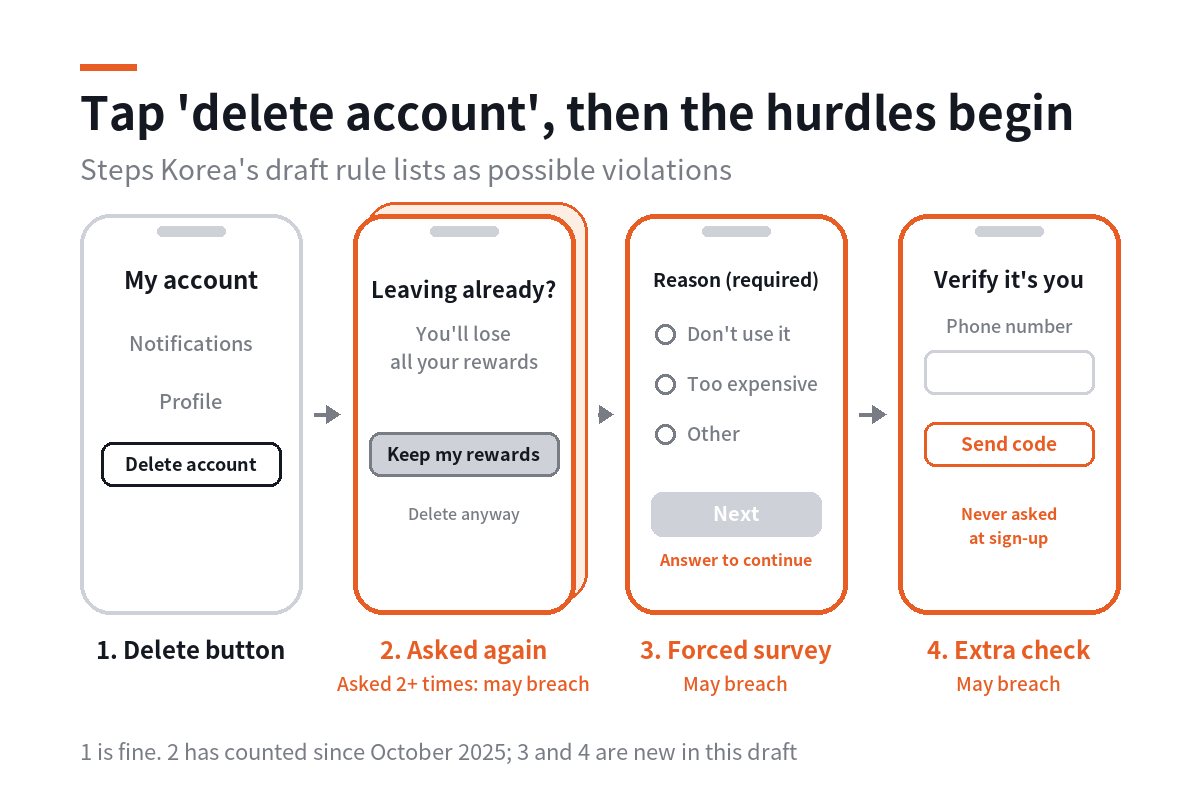
The test is how far a user has to dig. If a site puts its sign-up button on the home page, the delete-account button must appear either on the first screen a user sees after logging in or on a screen that page links to directly. It does not matter whether that second screen is called 'My page' or 'Manage account.'
Being on the second screen is not enough on its own. The draft also lists burying the button under menus where users would not expect it, such as profile editing, security settings or subscription management, as an example of a possible breach.
02Extra hoops at the exit
The draft names two more tactics. One is demanding phone, automated-call or email verification to delete an account, cancel an order or end a contract when the check is not essential to that step and was not required at sign-up or purchase.
The other is forcing users to answer a survey about why they are leaving before they can go on. Both are listed as examples of obstructing cancellation.
The draft also covers returns. Korean law lets sellers refuse to take back made-to-order goods only when a return would cause them serious harm they cannot recover from. Telling shoppers that an item cannot be returned simply because it was made to order, with notices such as 'produced after you order, no returns,' would be listed as an example of a breach.
A separate recommendation, not a rule, asks sites not to make users scroll a long way to find the seller's address, phone number and business registration number.
03From advice to rule
Korea already bans making it hard to cancel. Since February 14, 2025, its e-commerce law has outlawed six kinds of manipulative design, often called dark patterns, including hidden renewals and making it harder to cancel than to sign up.
Guidance on how to read that law took effect on October 24, 2025. Asking users to confirm or reconsider their decision unnecessarily, two or more times, became an example of a breach. Button placement did not. Advice to put the button in an account menu appeared only among the guideline's recommendations, which businesses are asked, not required, to follow.
The new draft moves button placement into the part of the guideline that sets out what breaks the law. The commission says it is targeting the issues that produced the most violations and complaints.
The draft does not cite them, but checks from February to July 2025 show the backdrop. The commission and the Korea Consumer Agency got 36 companies to fix, or submit plans to fix, 45 suspected dark patterns. Obstructing cancellation was the most common type, with 15 cases. Nine were at rental and car-rental firms, some of which had accepted cancellations only by phone and now allow them online. Those cases involved phone-only cancellation and repeated 'are you sure?' steps, not button placement.
04How Germany and the US compare
Germany went further in July 2022. Section 312k of its civil code requires a cancellation button for paid subscriptions and other ongoing contracts that can be signed online.
The button may carry only the words 'cancel contracts here' or something equally clear. It must lead straight to a confirmation page with a 'cancel now' button, and both must be available at all times and easy to reach. Financial services are exempt.
In the United States, the Federal Trade Commission voted 3-2 in October 2024 for a rule requiring cancellation to be at least as easy as signing up. On July 8, 2025, the Eighth Circuit Court of Appeals struck the rule down in full.
The court ruled on procedure, not substance. Once an FTC administrative law judge found the rule would cost the economy more than $100 million a year, the agency was required to publish a preliminary regulatory analysis, and it did not.
Korea's draft does not dictate button wording or a confirmation step, as Germany's law does. Instead it sets a maximum depth. The US rule created new duties; Korea's draft only sets out how the regulator reads a ban already in statute.
05What happens next
Comments can be sent to the commission's consumer transactions policy division by post, email or fax until November 26. The commission will also consult other ministries before finalising the change. No start date has been set.
The examples describe conduct that may break the law; each case is still judged on its facts. After its 2025 checks, the commission said firms that failed to carry out promised fixes would face corrective orders and fines.
If the draft is adopted, services that tuck the delete button deep inside their settings will have to redesign.