Korea's regulator says Baemin and Coupang stopped restaurants from selling cheaper on other apps. Europe fought the same fight over hotel apps a decade ago
Korea's competition watchdog gave the two delivery apps provisional fines totaling 631.9 billion won. We look at what changed in Europe after it banned the same kind of clause.
01The terms the apps set for restaurants
On November 9, the Korea Fair Trade Commission released details of its sanctions on Baedal Minjok (Baemin) and Coupang Eats. The fines are 331.1 billion won for Baemin and 300.8 billion won for Coupang. Both are provisional. The commission decided on October 29.
The core issue is the most-favored-nation (MFN) demand: give us terms at least as good as you give any other app. From July 2023 to January 2026, Coupang told restaurants that six things could not be worse on its app than elsewhere: menu prices, minimum order, discounts, customer delivery fees, number of menu items and opening hours. Restaurants that did not comply lost their 'WOW store' status, so Coupang's WOW members could not get discounts there.
From May 2024 to October 2025, Baemin made the same kind of demand on three things: minimum order, menu prices and discounts. Restaurants that did not comply were dropped from 'Baemin Club stores'. WOW stores that accepted the terms rose from about 13% in July 2023 to about 94% in October 2025, and Baemin Club stores from about 63% in May 2024 to about 80% in January 2025.
02Why terms instead of lower fees
Coupang charged higher fees than Baemin, and many restaurants priced their menus higher on Coupang Eats to cover them. Instead of lowering fees, Coupang demanded equal prices.
In August 2024, Baemin raised its fee for its own delivery service from 6.8% to 9.8% and made MFN demands at the same time. The commission said that when two companies with more than 90% of the market together did this at once, the effect looked like a cartel. Small apps with low fees lost their main way to win customers: getting restaurants to sell cheaper there.
03How store delivery was pushed aside
Baemin offers 'store delivery', where restaurants arrange their own riders, and its own delivery services. Store delivery has lower fees. The commission found that Baemin pushed restaurants into its own delivery by showing store-delivery restaurants less and scrapping a flat-fee plan. Restaurants on store delivery fell from 256,000 in June 2021 to 91,000 in July 2025.
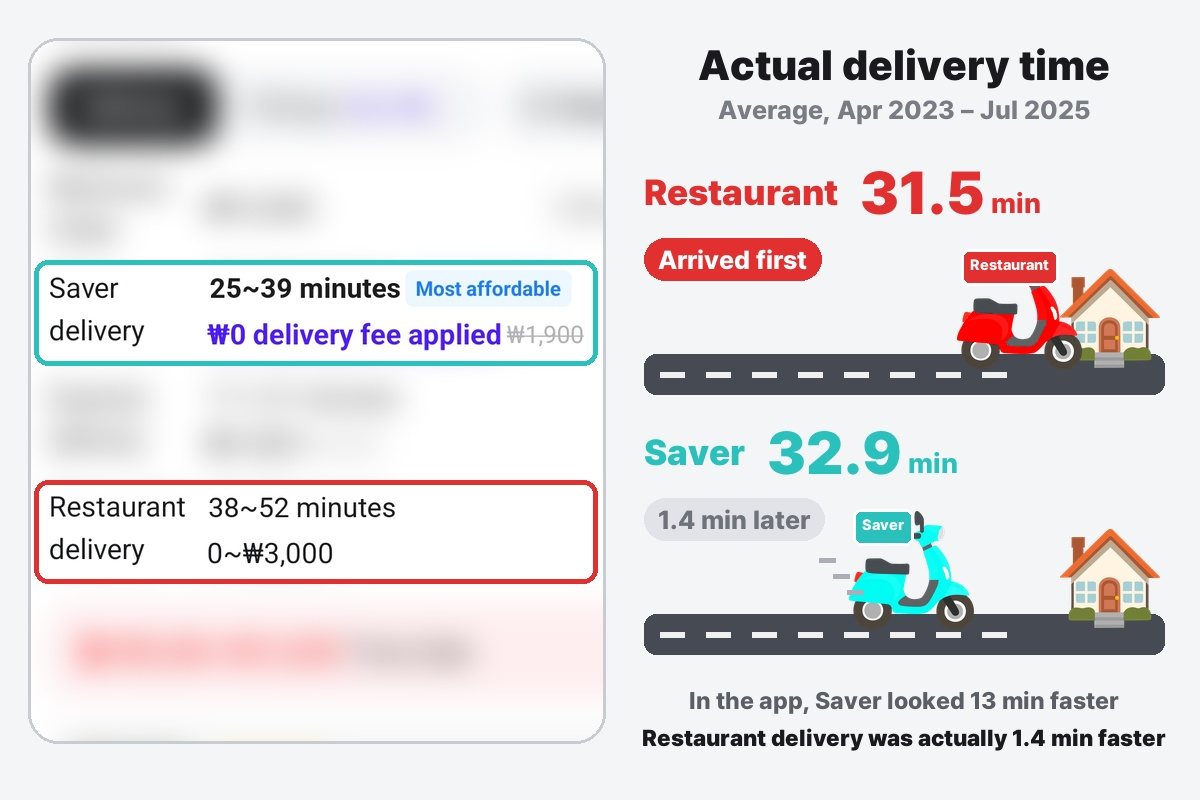
Delivery time estimates were also an issue. On average from April 2023 to July 2025, store delivery actually took 31.5 minutes but the app showed 44.7. Baemin's budget delivery took 32.9 minutes and the app showed 31.7. Store delivery was really 1.4 minutes faster, yet looked 13 minutes slower on screen. The commission ruled this deceptive advertising.
04What hotel apps in Europe went through first
The same kind of clause first became an issue in hotel booking. Until June 2015, Booking.com did not let hotels sell cheaper anywhere else. From July, it narrowed the rule to hotels' own sales channels, such as their websites.
Germany's Federal Cartel Office ruled on December 22, 2015, that even the narrow clause was illegal and ordered it removed. Germany's Federal Court of Justice upheld that decision on May 18, 2021. On September 19, 2024, the EU Court of Justice ruled that such clauses are not necessary for running a platform and risk pushing out small platforms and new entrants. The EU named Booking.com a gatekeeper under the Digital Markets Act on May 13, 2024. That law bars gatekeepers from stopping business users from setting different prices elsewhere.
Damages claims followed. On December 16, 2025, a Berlin court ruled that Booking.com must pay any damages to 1,099 accommodation providers. It did not decide whether or how much harm each suffered, and it rejected a claim to refund commissions. The ruling is not final.
05Will food get cheaper?
European research offers a clue. Economists analyzed prices at nearly 30,000 hotels in several countries and published the results in the International Journal of Industrial Organization in 2018. Chain hotels' own websites more often had the lowest price after Booking.com dropped the clause. Hotels listed rooms on Booking.com more often where it did not use the clause. The study did not show whether hotel prices fell overall, and there is no guarantee that hotel findings carry over to delivery apps.
For delivery apps, that suggests restaurants will be able to sell for less on low-fee apps or public delivery apps. The commission also said restaurants can now set menu prices and minimum orders separately for each app. That does not mean every menu price will fall at once. It is closer to prices differing by app, with a cheaper way to buy the same dish depending on where you order.
06The fines are not final
Both companies pushed back, saying they did nothing illegal. Under Korea's competition law, they have 30 days from receiving the written decision to sue, and the Seoul High Court hears the case. In Germany, the Booking.com case took more than five years from the order to the top court's ruling.
The commission also ordered Coupang to fix its terms. Coupang charged a 2-7.8% brokerage fee and a 3% payment fee based on the price before discounts, so restaurants paid fees even on the discounts they gave. Coupang must fix the clause within 60 days of the order. A separate charge against Coupang for forcing restaurants to use other services will be reviewed again.