South Korea hits 15 banks and brokers with record $1.2bn fine for rigging government bond auctions
Korea's competition watchdog says the dealers that buy the government's bonds swapped and fixed their bids for three and a half years, pushing up the rate the state paid. The fine is more than double Korea's previous cartel record, and about three times, at today's exchange rates, what Europe charged banks in a similar case.
01A five-second phone call
"I'm going to write 70." "70?" "Yeah." That exchange, between staff at two Korean financial firms on the day of a government bond auction, settled their bid at 3.70%. It took five seconds.
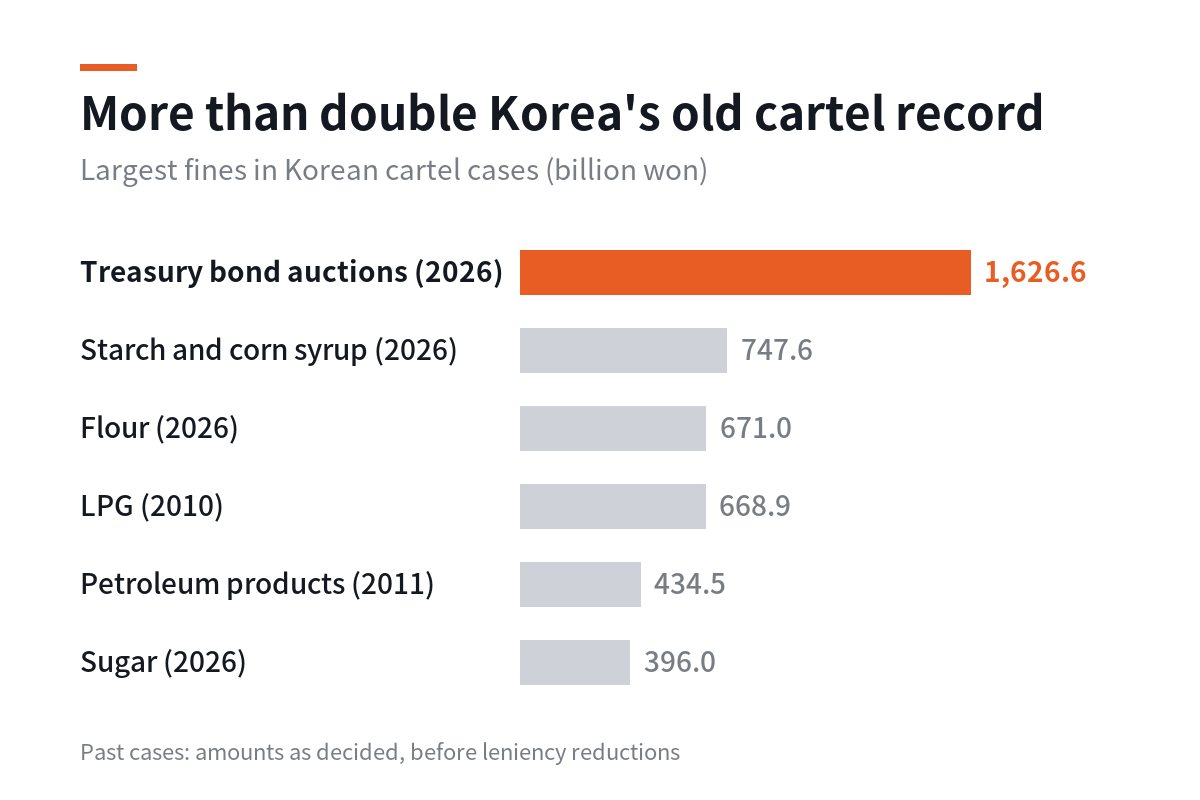
South Korea's Fair Trade Commission, the country's competition watchdog, released excerpts of the call on November 11 as it fined 15 of the government's primary dealers a combined 1.63 trillion won, about $1.21 billion. Ten are brokerages and five are banks. KB Securities faces the largest share, 332.2 billion won (about $248 million). It is the biggest fine in any Korean cartel case, more than double the previous record of 747.6 billion won (about $557 million) for a starch and corn-syrup cartel. Seven firms with the longest and most frequent involvement were referred to the Serious Crimes Investigation Agency, Korea's new criminal investigation body for major cases. They include two state-run lenders, Korea Development Bank and Industrial Bank of Korea.
The case covers January 2020 to June 2023. Of 345 Korea Treasury Bond auctions in that period, the commission says dealers swapped or fixed their bids in 150. In 145 of those, they agreed on the actual rate or amount to bid.
02How Korea sells its debt
Think of a Korea Treasury Bond auction as the government asking: at what interest rate will you lend us money? Bids are filled from the lowest rate upward until the issue is sold. Only primary dealers, and a few firms on probation to become primary dealers, can bid. Primary dealers are banks and brokerages chosen by the Ministry of Economy and Finance. There were 18 at the time.
When dealers compete hard, the government borrows cheaply and dealers pay more for the bonds. That is what the dealers were trying to avoid.
The rules gave them more reasons. Each dealer had to buy at least 10% of every issue. But a losing bid could still count partly toward that quota if it came close: within 0.02 percentage points of the winning rate for 2-, 3- and 5-year bonds, or 0.03 points for longer and inflation-linked bonds. Traders call the rate they actually hope to win at the "buy" rate, and the higher rate placed just to earn quota credit the "goalpost". The dealers shared or matched both.
From March 2021 to June 2023, every winning dealer got the same rate, the highest one accepted. Push that last rate up, and every winner earns more.
Being a dealer also pays. Dealers hold an option to buy more bonds at the winning rate for three business days after an auction. If market rates fall in the meantime, they profit. If rates rise, they walk away. The dealers used that option in 204 of the 345 auctions.
03What the evidence shows
The commission backed its case with numbers. Two firms that traded rate information often submitted the same rate in 46.7% of auctions during the cartel period in 2023. In the second half of that year, after it ended, the figure was 8.5%, though the end of the cartel also coincided with a change in auction rules. Each comparison covered 47 auctions. Within the cartel period, it was 55.6% on days the two firms spoke by phone before bidding and 18.2% on days they did not.
The contacts were built to last. Staff passed rivals' phone numbers to their successors. One firm's manual told traders to check the rates of "at least five firms" 15 minutes before each auction.
The commission concluded that the cartel artificially raised winning rates. It did not say how much extra interest the government paid as a result.
04Europe has been here before
In May 2021 the European Commission found that seven banks ran a cartel in euro-area government bonds between 2007 and 2011. Traders swapped prices and volumes ahead of auctions in Bloomberg chatrooms.
Only three paid: Nomura, UBS and UniCredit, a combined €371 million, about $415 million. NatWest, then RBS, escaped a fine because it reported the cartel. Bank of America and Natixis had left the cartel too long before the investigation began to be fined. WestLB, now Portigon, was fined nothing because it had no turnover in the previous year, and EU fines are capped at 10% of turnover. At today's exchange rates, Korea's penalty is roughly three times what Europe actually imposed.
Korea's watchdog cites the European case itself, noting that traders there also skipped the small talk on auction days and swapped figures almost at once. Both markets, it says, feature a handful of dealers bidding in the same auctions again and again on a tight clock.
05Who pays, and what comes next
The rate set at these auctions is the interest the Korean state pays on its debt, so a higher winning rate means more tax money spent on interest. Treasury yields also serve as the benchmark for pricing other loans and bonds in Korea.
There is a worry running the other way. Several Korean outlets report concern among finance officials and in the industry that dealers may now buy fewer bonds, making it harder for the government to borrow. The industry has pushed back. During the hearings, the dealers argued that sharing information helped them bid for more bonds; the commission said they failed to prove it. The firms can still ask the commission to reconsider or challenge the ruling in court.
Dealers must now buy 8% of each issue, down from 10% during the cartel period. Two more banks, Shinhan and Woori, became primary dealers in April, bringing the total to 20. It is now up to the Serious Crimes Investigation Agency whether to open criminal cases against the seven referred firms.