Ebola travel rules: who must sign the new US attestation form, what happened to the green card ban, and why WHO objects
Since late on November 3, everyone boarding a flight to the United States from abroad must sign a form saying they have not been in the Democratic Republic of the Congo in the past 21 days. It is the second layer of US Ebola rules. The first, an entry ban in place since May that also covered green card holders, expired on November 10, and no renewal had been published as of November 11. The World Health Organization advises against travel restrictions.
01A form for everyone on board
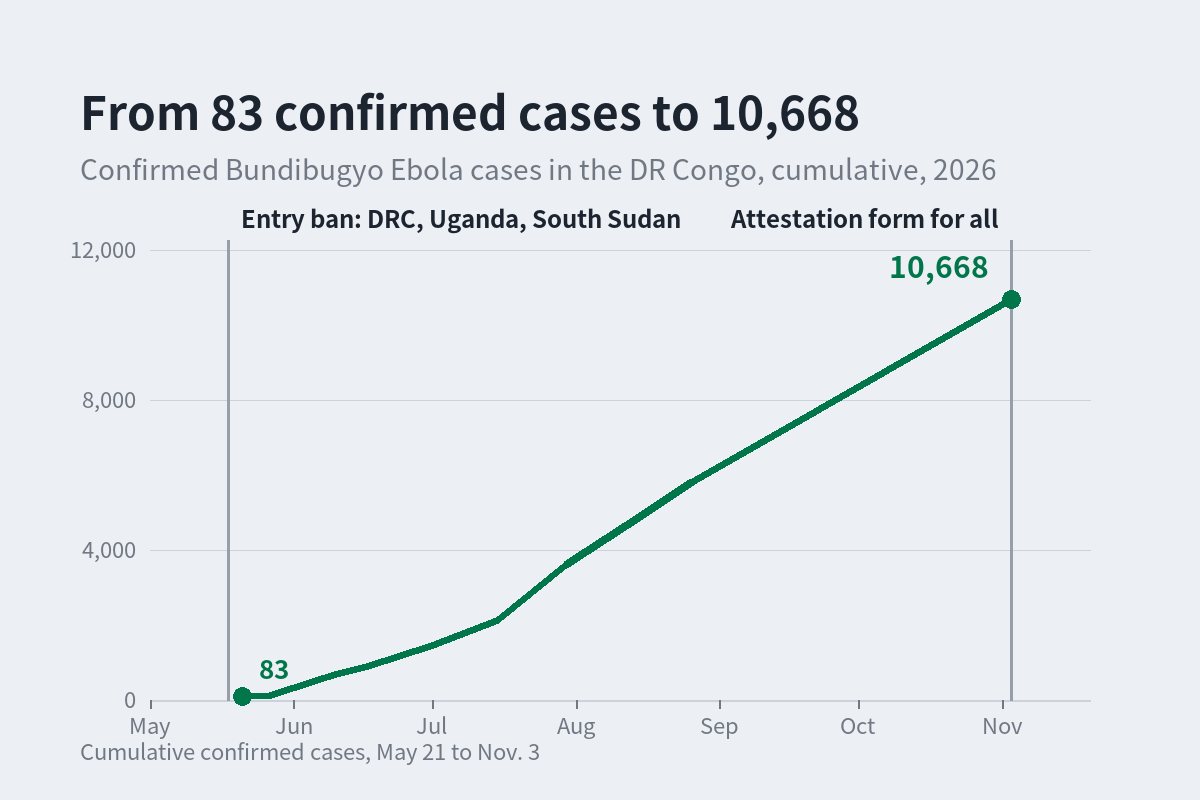
Since 11:59 p.m. Eastern time on November 3, no one can board a US-bound flight from abroad without signing a short form. It says the traveler has not been in the Democratic Republic of the Congo (DRC) in the past 21 days. The assistant secretary for health at the Department of Health and Human Services signed the order on October 22. The CDC enforces it. It applies to everyone, including US citizens and green card holders: an American who was in Congo in the past 21 days cannot board without a CDC exemption.
An amended order on October 28 extended the rule to crew members and spelled out that cargo flights count. Passengers who are only connecting through the United States were covered from the start. The order runs through December 18. Airlines must keep the signed forms for at least 42 days. Knowingly lying on the form is a federal crime under the false-statements law, and the CDC can ask the Justice Department to prosecute. The only exemptions are flights carrying Ebola patients with US approval and case-by-case CDC waivers, such as medical evacuations.
02The older layer: an entry ban for three countries
The form sits on top of an earlier rule. On May 18, the Centers for Disease Control and Prevention barred non-citizens who had been in the DRC, Uganda or South Sudan in the previous 21 days. On May 22, an amendment removed the exemption for lawful permanent residents, so green card holders are covered. US citizens and nationals are exempt. So are service members and US government staff posted abroad, if their agencies give the required health assurances.
The Department of Homeland Security also funneled travelers from those three countries to a short list of US airports. Each order lasts 30 days and has been reissued roughly monthly: June 21, July 13, August 12, September 11 and October 11. The October order expired at 4:59 p.m. Eastern on November 10. As of November 11, no new order had appeared in the Federal Register. Orders usually appear there days after they are signed; the October 11 order was published on October 15.
03Why every traveler, not just those coming from Congo
The CDC says much of Congo's spread is going undetected. In Ituri province, about 80% of new cases were not linked to known contacts. Across Congo, only about 20% of cases were found by tracing contacts.
Routes matter too. Kenya's first patient went from the DRC to Uganda, then flew from Kampala to Nairobi in early October. In its October 11 order, the CDC lists Addis Ababa, Nairobi, Brussels, Doha, Dubai and Istanbul as hubs that connect central and east Africa with JFK, Dulles, Atlanta, O'Hare and Los Angeles. Kenya went on to record nine cases, including four health workers, and two deaths, with no new cases since October 19. Nigeria confirmed an imported case in Abuja on October 20; the patient was later evacuated to Switzerland. A traveler's departure airport says little about where they have been. A signed statement asks the person directly.
04WHO says the opposite
The World Health Organization repeated on November 6 that it advises against any travel or trade restrictions on affected countries. Its August 14 risk assessment rated the risk very high in the DRC, high in neighboring countries and low globally.
Pushback has been thin but pointed. The only public comment on the September order asked the agency to publish measurable criteria for adding and removing countries, and questioned covering green card holders and people who only changed planes.
05A strain with no vaccine
This outbreak is caused by the Bundibugyo virus, a rarer Ebola species. No vaccine or treatment is approved for it. The two earlier Bundibugyo outbreaks, in Uganda in 2007 and the DRC in 2012, had fatality rates of 30% and 50%.
By November 3, the WHO counted 10,668 confirmed cases and 5,198 deaths in the DRC, a fatality rate of 48.7%, across 67 health zones in eight provinces. The CDC says that 100 days after detection there were seven times as many cases as at the same point in the 2014 West Africa epidemic. A trial of vaccine candidates began in Bunia on October 23, and WHO advisers have recommended adding two more: one from the University of Oxford and one from Moderna.
06What it means if you are flying to the US
The form applies on every route, including flights from London, Mexico City, Tokyo or Seoul. Anyone who was in the DRC within 21 days cannot board without a CDC waiver. The order ends on December 18 unless the CDC extends it, a decision it says will rest on case counts and spread.