October 2026 CPI: Why there is no annual inflation rate, and what it would likely be
US consumer prices rose 0.4% in October, the Bureau of Labor Statistics said on Tuesday. The report had no year-over-year inflation rate, because the fall 2025 government shutdown stopped price collection in October 2025. Applying the method the BLS used to fill that gap, HOLT NEWS estimates the annual rate at about 4%.
01The number most people look for is missing
If you opened Tuesday's inflation report looking for the annual rate, you did not find it. The Bureau of Labor Statistics, the Labor Department's statistics agency, said consumer prices rose 0.4% in October on a seasonally adjusted basis, slower than September's 0.6%. Core prices, which leave out food and energy, rose 0.3%. Shelter costs rose 0.3% and made up more than 30% of the monthly increase. Energy rose 0.7%, gasoline 1.0% and food 0.5%.
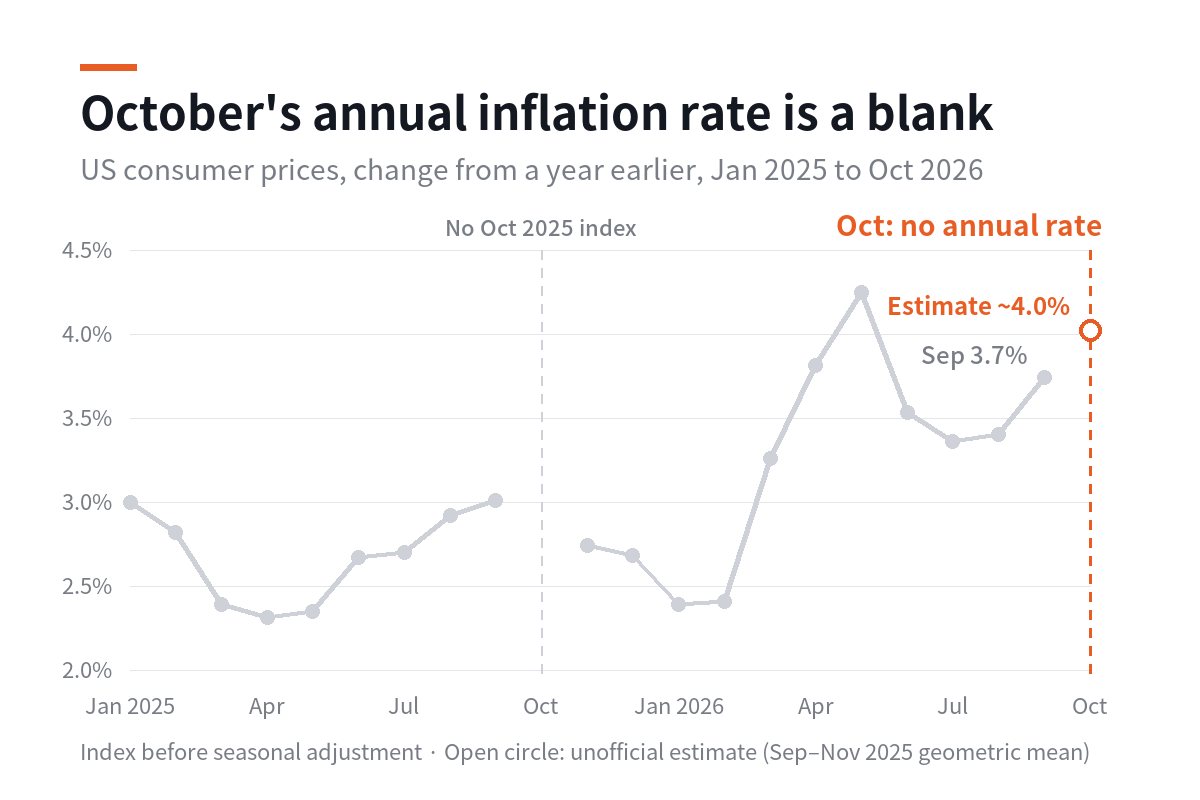
The year-over-year figure, the one most headlines lead with, is a dash. The BLS said it cannot publish 12-month changes for October 2026 for any index without October 2025 data. In its summary table, only three items carry an annual figure: gasoline (up 37.4%), new vehicles (up 0.7%) and used cars and trucks (down 3.3%). Those indexes draw partly on data from outside the BLS's own price survey, which the agency was later able to obtain for October 2025.
02Why October 2025 is empty
The federal government shut down from October 1 through November 12, 2025, after Congress failed to pass funding. BLS staff who normally record prices in stores and survey landlords stopped work. The September 2025 data had already been collected, so the agency recalled some staff and published it on October 24, nine days after the original October 15 date. It never issued an October 2025 CPI report. Price collection resumed on November 14.
To build the November 2025 index, the BLS filled the empty October prices with September's. Rents, which the BLS samples every six months, were carried forward from April 2025. So was owners' equivalent rent, the agency's measure of housing costs for homeowners. That left both unchanged for October. The BLS notes that carrying prices forward can understate inflation when prices are generally rising. The October 2025 index for all items was never published.
03Filling the gap: about 4%
For its seasonally adjusted series, the BLS estimated the missing October 2025 value as the geometric mean of the September and November indexes. HOLT NEWS applied the same method to the index before seasonal adjustment, which is the basis for annual rates. On that estimate, October 2026 prices were about 4.0% higher than a year earlier, and core prices about 2.8% higher. In September, the official annual rates were 3.7% and 2.6%.
A second shortcut compares October 2026 with September 2025, 13 months earlier: prices rose 3.9% over that span. Neither number is official. The safer conclusion is about direction: annual inflation in October was probably a little above September's 3.7%.
The 1.2-point gap between the headline and core estimates comes from food and energy, which core leaves out. Gasoline stands out. It is one of the few items that still has an official annual rate, and it is 37.4% more expensive than a year ago. If everyday costs feel higher than they did last fall, the gas pump is a big part of the reason.
04Next month's annual rate may run hot
The gap does not end in October. Because the November 2025 index rested on carried-forward October prices, it may be too low. The unadjusted index fell 0.2% from September to November 2025, from 324.800 to 324.122. Over the same two months in 2024, it rose 0.1%. The annual rate dropped from 3.0% in September 2025 to 2.7% in November.
If November 2025 was understated, the annual rate for November 2026 could be pushed up by the low starting point, even if prices are not rising any faster. The shelter index barely moved between September and November 2025, from 418.598 to 418.593, after rising 0.5% over the same two months a year earlier. Real price moves are mixed in too: gasoline fell 3.3% over those two months. The BLS has not said how much of the dip came from the gap, or how it will handle 12-month changes for November.
05The last CPI before the Fed decides
On October 28, the Federal Reserve held the target range for its benchmark federal funds rate at 3.75% to 4%. The vote was 10 to 2: Governor Lisa Cook and Cleveland Fed President Beth Hammack wanted a quarter-point hike. The statement said inflation remains elevated.
The Fed meets again on December 8 and 9. The November CPI comes out on December 10, a day after the decision. That makes the October report, blank annual rate and all, the last CPI release policymakers will see before they decide. It is not their only gauge: the Fed's 2% target is defined in terms of a different measure, the personal consumption expenditures (PCE) price index. Their statement and new projections on December 9 will show how they read the October report.