A plastic spoon in your brain?
Alexander J. Nihart et al. · Nature Medicine, 2025
01Where the spoon came from
Matthew Campen's team at the University of New Mexico wanted to know where microplastics and nanoplastics, tiny fragments of plastic, build up in the human body, and whether the amount is rising. They measured plastic in liver, kidney and brain tissue taken during autopsies. The results appeared in Nature Medicine in February 2025.
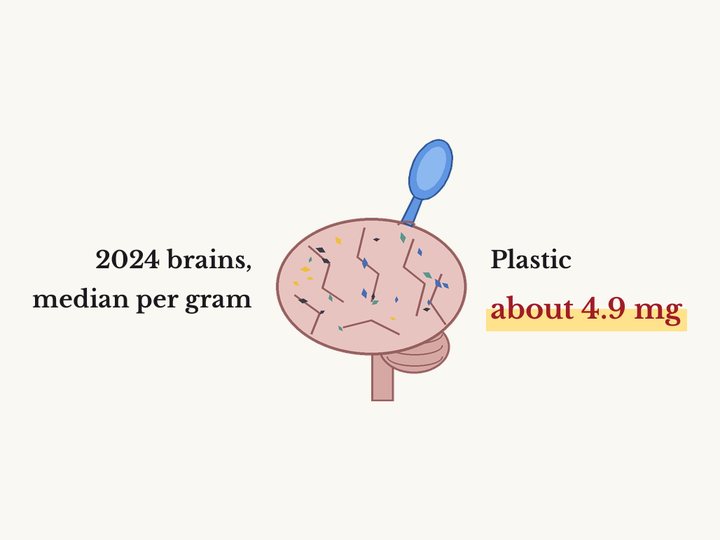
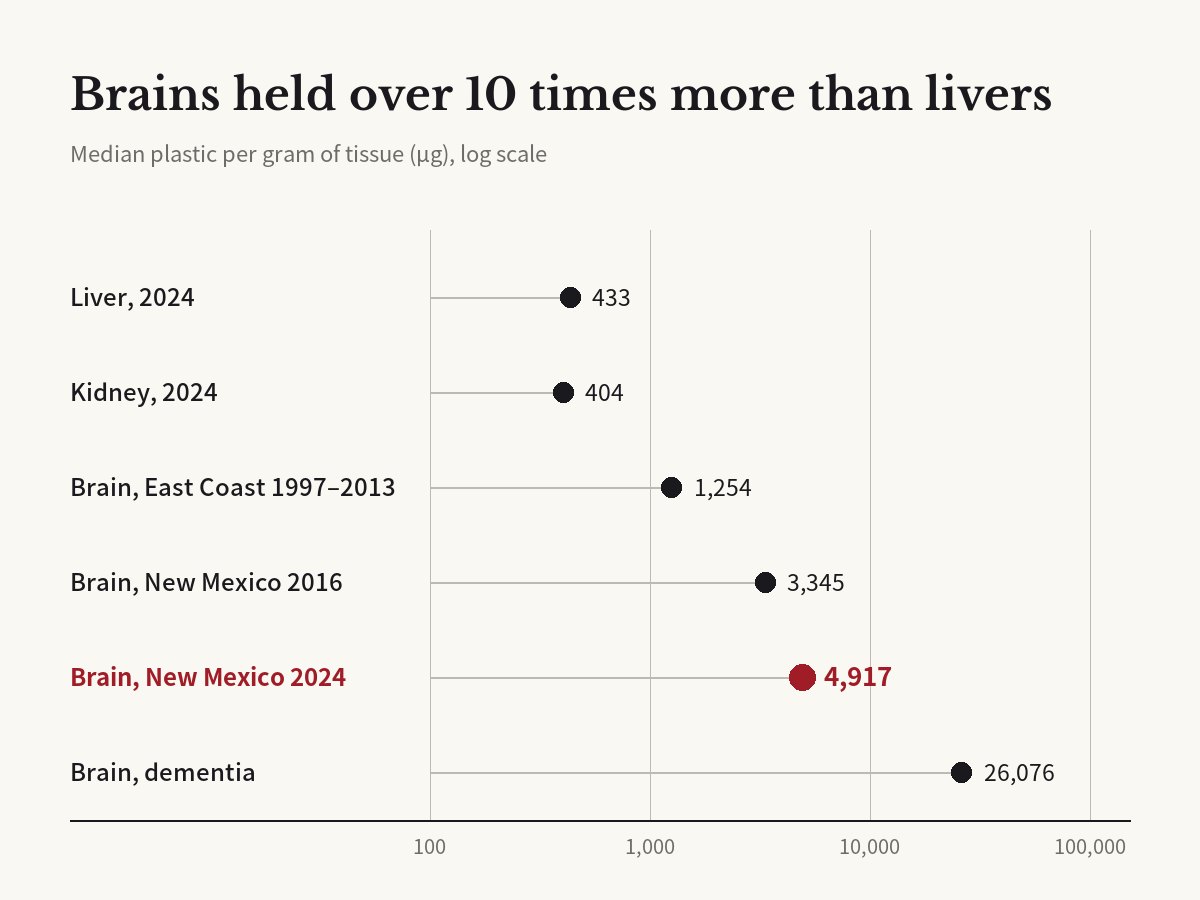
In people who died in 2024, the median amount of plastic per gram of tissue was 433 micrograms in the liver and 404 in the kidney. The brain held far more: 3,345 micrograms per gram in samples from 2016 and 4,917 in samples from 2024. That is roughly 0.5% of brain tissue by weight. Campen told CNN it was about one plastic spoon's worth per brain, and the image spread worldwide.
On average, 75% of the plastic found in the brain was polyethylene, the material in most plastic bags and food wrap, a higher share than in the liver or kidney. Under an electron microscope, most fragments were shards less than 200 nanometers long and 40 nanometers wide.
02Measured in the dead, not the living
Every sample came from someone who had died. The New Mexico Office of the Medical Investigator supplied tissue from autopsies done in 2016 and 2024, with 20 to 28 people for each organ in each year. All brain samples came from the frontal cortex.
The team used pyrolysis gas chromatography–mass spectrometry. Tissue is dissolved in a strong alkaline solution, and whatever is left is heated until it breaks apart. The breakdown products are then used to work out which plastics were present and how much. The team checked some samples with infrared spectroscopy and electron microscopy.
Plastic levels did not track age, sex, race or cause of death. Only the year of death mattered. The team also tested 27 brains from three brain banks on the East Coast, from people who died between 1997 and 2013. Those brains had a lower median, 1,254 micrograms per gram, though the authors said a regional difference could not be ruled out.
Brains from 12 people diagnosed with dementia had a median of 26,076 micrograms per gram. The authors wrote that this does not show plastic causes dementia. The disease shrinks the brain, weakens the barrier between blood and brain, and slows waste clearance, all of which could push plastic levels up on their own. Because the study measured tissue from the dead at a single point, it cannot show cause and effect.
03How much can we trust the numbers?
The brain figures stand out. Earlier studies found a median of 63.4 micrograms per gram in placentas and 299 in testes. The brain values were closer to those reported for plaque in the carotid arteries. What was new here was comparing liver, kidney and brain with the same method and tracking change over time.
The team described its quality checks. It ran 'blank' samples of the digestion and storage solutions alone, and measured what the plastic tubes and pipette tips used in the lab were made of. A lab at Oklahoma State University measured five of the 2016 brain samples separately and got similar values. The authors declared no competing interests.
The paper also flagged its own weak spot. Dissolving the tissue removed 99.4% of the mass of liver and kidney samples but only 91.8% of brain samples, leaving about 41 milligrams of residue from 500 milligrams of brain, against about 3 from the other organs. The authors wrote that unknown biological material in that residue could interfere with the analysis, and that lipids, the fats in tissue, are a known source of interference when measuring polyethylene. They said their dissolving method was designed to reduce that risk.
In March 2025 the authors published a correction that fixed duplicated supplementary images and wrongly sized scale bars and added a missing sample-preparation step. The concentrations reported in the main paper were not changed.
04A challenge in the same journal
In November 2025, Nature Medicine published a critique of the paper alongside a reply from its authors. The critique was written by nine researchers based in Europe, led by Fazel A. Monikh and Dušan Materić.
Their main concern was that the reported concentrations may not be reliable. They said the study had limited controls for contamination, the stray plastic that can enter samples from lab equipment and air, and skipped validation steps that would show the method works in human tissue. The sources they cite include work showing that results depend on how tissue is dissolved, and data on how much fat the liver and brain contain.
That is why fat matters. Polyethylene is a long chain of carbon and hydrogen atoms. Fatty acids also have long carbon chains, and when heated they can break down into similar fragments. The brain is one of the fattiest organs in the body, and it is where this study found the most plastic, most of it polyethylene.
05The method had already struggled with blood
Another lab had already run into this problem. In January 2025, a team at the University of Queensland in Australia tested the method on human blood and published the results in Environmental Science & Technology.
They developed a new extraction step to reduce false positives, in which natural parts of blood are misread as polyethylene or PVC. Even so, when known amounts of plastic were added to blood, the method recovered between 7% and 109% of it, depending on the type. Once the interference from blood was accounted for, realistic detection limits were up to 20 times higher than those calculated using pure water.
In a pilot test on blood from people in Australia, polyethylene interference was reduced but not eliminated. The team concluded that the method is not currently suitable for measuring polyethylene or PVC in biological samples. Polyethylene is the plastic the brain study found most.
06How the authors responded
In their reply, Campen and colleagues called the critique an opportunity to discuss the uncertainties in even the best methods now available for detecting nanoplastics. They listed the issues raised: the way tissue was dissolved, possible interference in the mass spectrometer from unknown biological molecules such as phospholipids, and specific quality-control steps.
The paper has not been retracted, and it had been cited 928 times as of November 2026. The challenge does not mean the body is free of plastic. The dispute is over how much is there, and whether this method can measure it reliably.
07What to keep in mind
The spoon comparison, as reported, scales the 2024 New Mexico median up to a whole brain. If fat inflated the measurements, the spoon shrinks too.
Most samples came from one region, New Mexico, with 20 to 28 people per organ per year. The rise from 2016 to 2024 compares different people who died in different years, not the same people measured twice.
The high levels in dementia come from 12 brains, and the authors themselves do not treat plastic as the cause. No one has yet shown what plastic in the brain does to memory or health.
Two questions remain open. What would a different method, one that rules out contamination and fat interference, find in human brains? And is the amount really rising year by year?
Original paper
- Nihart et al. (2025), Nature Medicine 31(4), 1114–1119, doi:10.1038/s41591-024-03453-1
- doi.org/10.1038/s41591-024-03453-1