Naver Pay–Upbit merger: Korea's antitrust staff see competition risks, even in a won stablecoin that doesn't exist yet
Upbit and Naver Pay are in different businesses, yet Korea's competition watchdog says putting them under one roof could reduce competition. It even weighed a won stablecoin market that does not exist yet. Still, the plan on the table is conditions, not a ban.
01When a crypto exchange joins a payment app
What happens when a country's biggest crypto exchange joins one of its biggest payment apps? South Korea is about to find out. On November 10, the Korea Fair Trade Commission (KFTC), the country's competition watchdog, said its full commission would now take up a deal between Naver Financial, which runs Naver Pay, and Dunamu, which runs Upbit, Korea's biggest crypto exchange. Naver Financial is a subsidiary of Naver, the company behind Korea's top search portal.
The deal is an all-stock swap. Naver Financial would acquire all of Dunamu's shares, and Dunamu shareholders would get about 2.54 Naver Financial shares for each share they hold. According to Naver's filing after its board approved the deal on November 26, 2025, an outside valuation put Dunamu at about 3.06 times the value of Naver Financial. Naver Financial would issue new shares worth about 15.13 trillion won, roughly $11.2 billion.
The two companies mostly do different things. People use Naver Pay to pay for things and Upbit to trade crypto. Even so, the commission's investigating staff concluded that the deal could substantially restrict competition, and sent their report to both companies on November 6. The final decision rests with the full commission, the KFTC's nine-member decision-making body.
02Three kinds of mergers, three kinds of risk
Why would a deal between companies in different businesses worry a competition regulator? It helps to start with how regulators sort mergers. There are three kinds. A horizontal merger joins direct rivals, like two instant-noodle makers. A vertical merger joins companies at different steps of the same chain, like a flour mill and a noodle maker. Everything else is a conglomerate merger, like a noodle maker buying a detergent brand.
Each kind raises a different question. Under the KFTC's merger review guidelines, a horizontal deal is checked for whether losing a rival lets the merged firm raise prices, or makes it easier for the remaining firms to act together. A vertical deal is checked for whether the combined firm can cut competitors off from supplies or customers. A conglomerate deal is checked for three things: whether a likely future rival disappears, whether strength in one market is used to push rivals out of another, and whether it becomes harder for anyone new to get in.
03Ten markets, twelve links
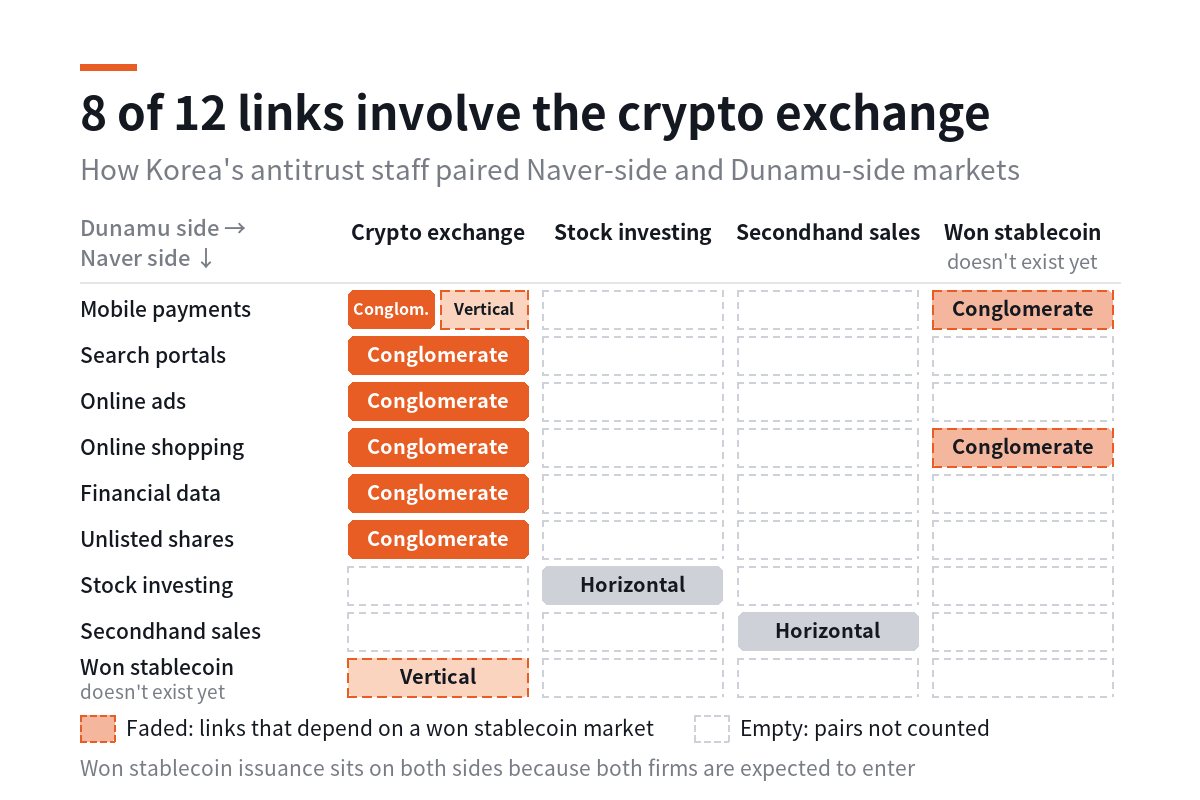
The staff started by defining the markets the deal touches. They came up with 10: mobile payments, crypto exchanges, search portals, online advertising, online shopping, financial data-sharing services, trading in unlisted shares, platforms for investing in listed stocks, online secondhand marketplaces, and the issuance of stablecoins pegged to the Korean won.
Each link is a pair: one Naver-side market and one Dunamu-side market that would end up under the same roof. The staff identified 12 such links, shown as the colored cells in the chart above.
Two are horizontal: stock-investing platforms and secondhand marketplaces, where both companies already operate. Both fell into a "safe harbor": market concentration is low or barely rises after the deal, so harm to competition is presumed unlikely.
Six are conglomerate links, and every one of them runs through the crypto exchange market. Upbit would be tied to mobile payments, search, advertising, shopping, financial data and unlisted-share trading. The staff stressed that the deal would bring together market leaders, such as Korea's top mobile payment service and its top crypto exchange.
The staff did not count every possible pair. Among existing markets, they counted only the two horizontal links and the six pairs with the crypto exchange. Everything else was left out, including the exchange paired with stock investing or secondhand sales, and Naver's payments or search paired with Dunamu's stock-investing and secondhand businesses. The KFTC has not said how it chose.
04Counting a market that doesn't exist yet
A market for won stablecoins does not exist yet. A won stablecoin is a crypto token designed to hold its value at one Korean won. Korea has not yet passed a law that says who may issue one. Korean media report that a government bill is due this month.
Both companies are expected to enter that business, so the staff added four links that would appear once it exists. Issuing a stablecoin and running an exchange, and running an exchange and a payment app, are vertical links. Issuing a stablecoin and running a payment app or a shopping site are conglomerate links.
That means the exchange and payment-app pair is counted twice: once among the six conglomerate links and again as a stablecoin-related vertical link. The KFTC did not explain why, but the likely reason is that a stablecoin changes how the two relate. Today, buying crypto and paying for groceries are separate activities, so the link is a conglomerate one. Once a won stablecoin exists, a coin bought on Upbit could be spent through Naver Pay, turning the two into steps of the same chain. The question then is no longer only whether Naver steers customers to Upbit, but also whether it shuts out other exchanges and payment firms.
Put together, one company could end up minting the coin, listing it for trading and letting you pay with it at checkout. The regulator put that chain under review before the market even exists.
05What could you lose?
The KFTC has not said exactly which behavior worries it. For users, the guidelines suggest what could go wrong: Naver search, Naver shopping and the Naver Pay checkout screen could steer you toward Upbit or a Naver-linked stablecoin. Once a won stablecoin exists, Naver Pay could refuse coins bought on other exchanges.
Other exchanges and payment companies would then have fewer ways to reach customers. With fewer places to choose from, the biggest company has more room to set fees and terms.
06Conditions, not a ban
The staff are not asking the commission to block the deal. They want conditions attached: a mix of things the companies must do and must not do. The details have not been made public.
Those conditions started with the companies themselves. When the staff told them the deal raised competition concerns, the two companies proposed ways to ease them. The staff asked for changes, and the companies sent back a final version. The staff then set their conditions with that final version in mind.
The conditions are not settled yet. The full commission makes the final decision and can change them or add more.
07What's left before the deal closes
The KFTC says the full commission will hear the case soon. After that, the deal still needs approval from financial regulators, including for a change in Naver Financial's major shareholder under Korea's credit information law, according to Naver's filing. Korean media also report that the government's planned digital asset law may cap any single shareholder's stake in a crypto exchange at 15% to 20%. That matters here because the deal would make Naver Financial the sole owner of Upbit's operator.
After several amended filings, the share swap is now set for March 31, 2027, nine months later than first planned. Shareholders at both companies still have to approve it.