For the first time, more than half of Korean employees earn 3 million won or more a month
The share earning 5 million won or more also hit a first-half record, but the gap between industries was wide.
01What happened
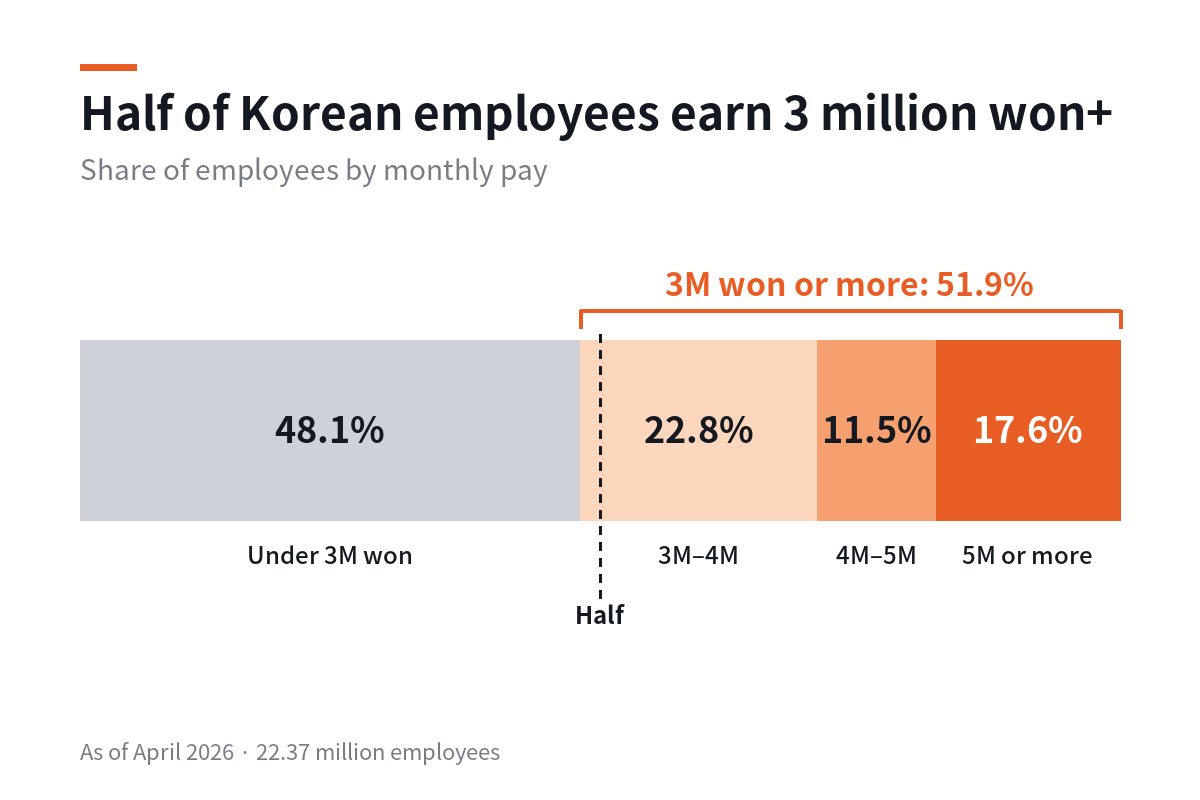
On October 27, Statistics Korea released its first-half regional employment survey. 51.9% of wage earners made 3 million won or more a month. It is the first time the share passed half since the survey began in 2013.
The survey reflects April of this year and covers 22.37 million employees. Pay means the monthly average from the main job over the past three months, including bonuses and pay in kind.
02How pay was spread
22.8% earned between 3 and 4 million won, 11.5% between 4 and 5 million won, and 17.6% earned 5 million won or more. Each share rose from a year earlier, by 0.4, 0.3 and 1.2 percentage points.
The 5-million-plus share was the highest first-half figure on record. 48.1% earned less than 3 million won, and the 2-to-3 million won band, at 29%, remains the largest group. 9.3% earned 1 to 2 million won, and 9.8% less than 1 million won.
The bands that shrank tell the story. The 2-million band fell by 1.6 points and the 1-million band by 0.6 points in a year. This suggests some people who earned in the 2 millions moved above 3 million won.
03Why pay rose
Wages went up. Large bonuses in the first half, mainly at chip companies, are seen as a driver of the rise in high earners.
Because the survey counts bonuses, the top bands grow in years with big bonuses.
04The bottom grew too
The share earning less than 1 million won also rose, from 9.6% to 9.8%. That is about one in ten workers.
Both ends grew at once, so some see the result as a sign of widening pay gaps.
05Big gaps between industries
In finance and insurance, 40.5% earned 5 million won or more, the highest of any industry. Professional, scientific and technical services followed at 37.5%, and information and communications at 35.8%. In manufacturing, the share rose from 22.9% to 25.4%.
In health and social welfare, only 5.8% did. This is where jobs are growing the most. Jobs at non-residential welfare facilities rose by 155,000 in a year to 1.843 million, or 6.4% of all workers. Hospitals added 64,000 jobs and local clinics 26,000.
As Korea ages, care jobs are growing, and older workers are mostly filling them.
06Different jobs at different ages
New jobs differed by age. People aged 50 and over gained 141,000 jobs at non-residential welfare facilities. The field has long been mostly women, but across all ages men gained 66,000 jobs there.
People aged 30 to 49 gained 38,000 hospital jobs and lost 34,000 in architecture and engineering services. People aged 15 to 29 gained 9,000 jobs each at hospitals and universities, and lost 18,000 in general retail.
Younger and middle-aged workers are moving into hospitals, while older workers are moving into care. The loss of architecture and engineering jobs among people in their 30s and 40s also stands out.
07Fewer employees
The number of wage earners fell by 43,000 from a year earlier.
Counting all workers, including the self-employed, crop farming lost 82,000, architecture and engineering services 62,000, and general retail 31,000.
The share of higher earners rose while the number of employees fell, so the result needs care. When low-paid jobs disappear, the remaining workers can look better paid even if their own pay did not change.
08What it means
The pay figures are not adjusted for inflation, so many may not feel as much better off as the numbers suggest.
Because much of the rise came from bonuses, it could reverse if the chip boom slows. Low pay in care work, where jobs are growing the most, may become a bigger problem as the population ages.
Corrections
- We removed rising prices as a reason for the higher share of top earners, as the sources did not support it. We also changed "growing fastest" to "growing the most" for health and social welfare jobs; the data show the largest increase in numbers, not the fastest rate.