California voters reject Prop 40 billionaire tax, keep tax on high earners
Voters turned down Proposition 40, a one-time 5% tax on billionaires' net worth, while backing Proposition 3, which makes a 2012 income tax increase on top earners permanent. Proposition 42, which would write a ban on new taxes on owning stocks and other personal property into the state constitution, is narrowly ahead.
01Three tax questions, three different answers
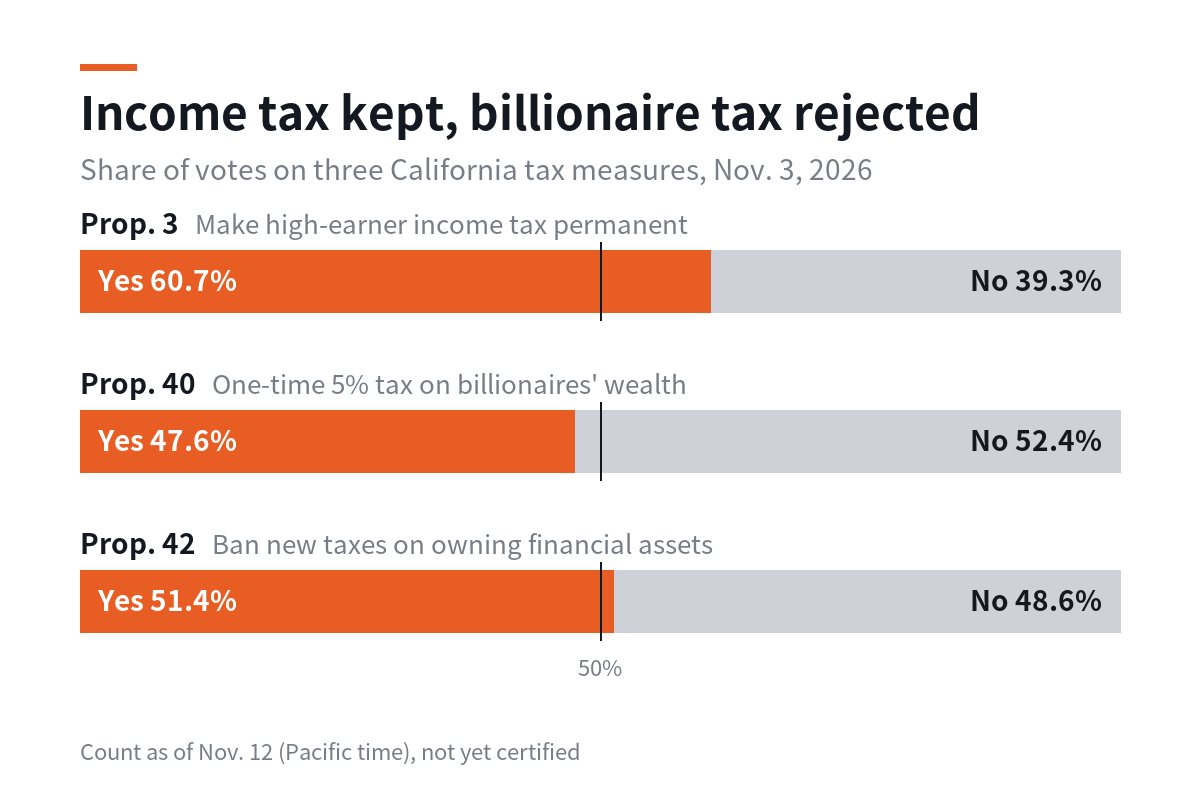
California voters on November 3 split on three ballot measures about taxing the rich. With counting still being finalized, Secretary of State figures as of the afternoon of November 12 show Proposition 40, a one-time 5% tax on the net worth of billionaires, failing by 52.4% to 47.6%.
Proposition 3, which makes a 2012 income tax increase on high earners permanent, is passing comfortably, with 60.7% of the vote. Proposition 42, a constitutional amendment that would bar new state taxes on owning stocks and other personal property, leads 51.4% to 48.6%, a margin of about 330,000 votes. None of the results is certified yet, and Proposition 42's lead is the only one close enough to matter.
02What the billionaire tax would have done
Proposition 40 would have applied to billionaires who were California residents on January 1, 2026, ten months before the vote. They would have owed 5% of their net worth, due in 2027, with the option to spread payments over five years at extra cost. Real estate, pensions and retirement accounts were generally excluded. A billionaire with $10 billion in taxable net worth would have owed $500 million.
The Legislative Analyst's Office, the legislature's nonpartisan fiscal adviser, estimated the tax would raise tens of billions of dollars over several years, with 90% earmarked for health care. It also warned that some billionaires might leave the state, which could cost California less than $1 billion a year in income tax. A few hundred people with a net worth above $1 billion live in California, according to the office.
03The tax on the rich that voters kept
Proposition 3 extends rates first approved by voters in 2012 under Proposition 30 and extended through 2030 by Proposition 55 in 2016. The higher rates apply only to the top 2% of taxpayers, who pay about half of all state income tax. The analyst's office expects the measure to keep $5 billion to $15 billion a year flowing to the state, depending largely on the stock market. Roughly 40% will go to schools and community colleges.
The contrast is between taxing what people earn and taxing what they own. An income tax is paid out of money that came in that year. A wealth tax is due whether or not the assets produced any cash, which can force owners of stock-heavy fortunes to sell shares to pay it.
04A constitutional lock on wealth taxes
California already taxes some personal property, such as vehicles through the annual license fee and business equipment through county property taxes. It does not tax simply owning financial assets like stocks or investment accounts. Proposition 42 would make it unconstitutional for the state to start.
The measure also limits retroactive taxes, which the analyst's office illustrates with a tax on money earned two years earlier. Proposition 40's residency date, January 1, 2026, fell ten months before Election Day. A related measure, Proposition 41, which would have added audits of new special taxes and made it harder to keep their revenue outside the state spending limit, failed with 55.1% voting no. The analyst's office had warned that if Proposition 41 drew more yes votes than Proposition 40, courts could block Proposition 40 even if a majority backed it. Both measures failed, so the conflict never arose.
05Wealth taxes elsewhere
Annual net wealth taxes have been retreating for decades. According to a 2018 OECD study, the number of member countries that levied one on individuals fell from 12 in 1990 to four in 2017: France, Norway, Spain and Switzerland. The OECD said repeals were usually justified on efficiency and administrative grounds, and that with a few exceptions the taxes raised very little money.
South Korea, where this publication is based, also does not tax simply holding shares or bank deposits. Its taxes on ownership fall mainly on real estate, through a local property tax paid by all owners and a national comprehensive real estate holding tax on owners of high-value property, and also on some movable property such as cars and ships.
06What happens next
Results become final once counties finish counting and the Secretary of State certifies them. Every precinct has reported, but ballots remain to be counted. If Proposition 42 holds its lead, a similar wealth tax could return only as a constitutional amendment that also overrides the new provision. Supporters of Proposition 40 have been reported as saying they will try again. The analyst's office said Proposition 42 could mean state revenue grows more slowly in the future, without estimating by how much or when.