Two in three South African councils have no majority... and the coalition law missed the election
Mandela's party, the ANC, fell to about 31% in local elections. Over 120 councils now need coalition deals, but the government's coalition rules are still stuck in Parliament.
01A party in power for 32 years falls to a third
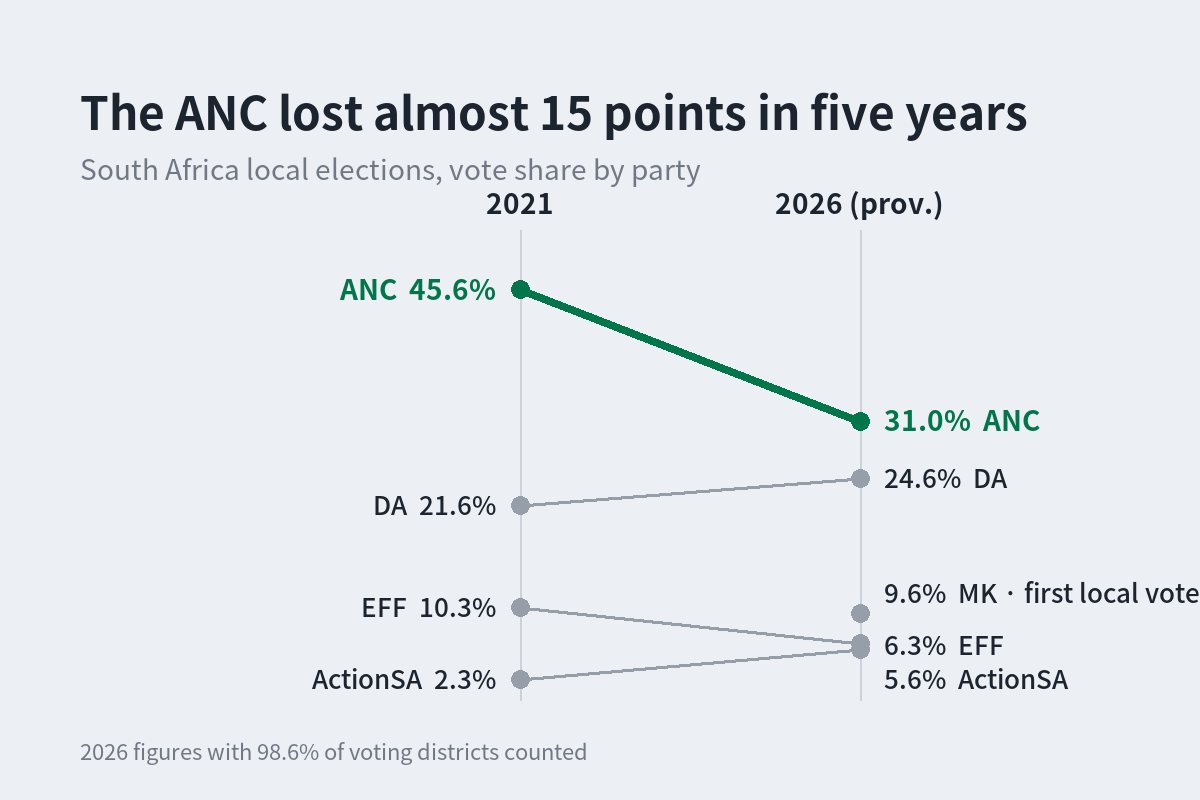
South Africa held local elections on November 4. With 98.6% of voting districts counted on November 7, the African National Congress, or ANC, had about 31%. The Democratic Alliance (DA) followed with 24.6%, then the MK Party at 9.6%, the Economic Freedom Fighters at 6.3% and ActionSA at 5.6%.
The ANC has led the country since 1994, when it made Nelson Mandela president in the first democratic election. Its local vote share was 54% in 2016 and 45.6% in 2021, the first time below half. This time it lost almost 15 more points.
In the 2024 national election, it also lost its majority in Parliament and formed a Government of National Unity with the DA and others. The MK Party was founded by former president Jacob Zuma in late 2023. This was its first local election.
Voters point to unemployment, crime, corruption, and frequent water and power cuts. Statistics South Africa puts the unemployment rate at 33.6% in the second quarter of this year, and 47.4% for people aged 15 to 34. One in three people looking for work has no job.
02Winning first place is not enough
In South Africa's municipal councils, a party with a majority of seats elects the mayor. A council where no party has a majority is called a hung council. There, parties must join hands to choose a mayor, and the party that came first can be shut out.
Of the 191 councils fully counted, 122 are hung. In 2021, 66 of the country's 213 local councils were hung. About one in three has become about two in three.
Of the eight big metros, only Cape Town, won by the DA, has a clear majority. The DA is first in Johannesburg, Tshwane and Ekurhuleni, but short of a majority. In Nelson Mandela Bay, it won 53 of 120 seats, eight short. In eThekwini, home to Durban, the MK Party is first.
Under current law, a council must hold its first meeting and elect a mayor within 14 days of the result being declared. Parties have two weeks to find partners.
03Johannesburg's five mayors
Johannesburg is the best-known case of coalitions falling apart. In less than three years after the 2021 election, the mayor changed five times. A DA mayor was voted out, returned by court order, and was then removed again. Two mayors from a party with only a few seats followed.
The government gave its reasons in the bill's memorandum. Hung councils have grown since there were 24 in 2000, yet there were no rules at all on how to form or run a coalition. The government wrote that votes for mayor and speaker were bought and sold, and that parties denied promised posts kept bringing no-confidence motions.
When a mayor changes, the mayor's team leaves too. Parliament said frequent no-confidence motions hurt public services such as water and electricity, and asked for coalition rules quickly.
04The government's rules, pushed past the vote
On August 18, the Department of Cooperative Governance and Traditional Affairs sent an amendment to the Municipal Structures Act to Parliament. It does three main things.
First, parties forming a coalition in a hung council must sign a written agreement, published in the provincial gazette for anyone to read. Second, a no-confidence motion against a mayor or speaker can be brought only once every 12 months, except for a breach of the Constitution, a criminal conviction, financial misconduct, a serious breach of the code of conduct, or inability to do the job. Third, the deadline for the first council meeting and mayoral vote rises from 14 to 30 days, to give parties more time to negotiate.
On August 28, Parliament's cooperative governance committee said the bill would not be finished before the election. Because the provinces must review it too, the process is long. In the last Parliament, bills of this kind took 34 months on average. The more than 120 hung councils formed this time will build coalitions under the old rules, with no duty to publish agreements and no limit on no-confidence motions.
05What the coalitions will change
At the national level the DA sits in government with the ANC. Locally, the two compete for mayors' offices. Who teams up with whom in each metro is seen as shaping the national coalition too.
If the new law passes, it may apply partway through the next council term. Mayors would then be harder to remove, and residents could check coalition promises against a published agreement.
06Things to keep in mind
Vote shares and hung-council counts are provisional, as of November 7. The Electoral Commission announces final results at 5:30 p.m. local time on November 8, or 12:30 a.m. on November 9 in Korea.
Hung-council counts depend on how they are counted. The government's memorandum says 81 after the 2021 election, while the Electoral Commission reported 66. The bill may also change as Parliament reviews it.