SS United States artificial reef: what came off, what stayed on
A Florida county has begun sinking the SS United States, which still holds the transatlantic speed record for an ocean liner, to make the world's largest artificial reef. The federal guide on cleaning ships before they are sunk is advice, not law, and it lets most intact paint stay on board. The dispute is now over that paint.
01From a Philadelphia pier to the Gulf floor
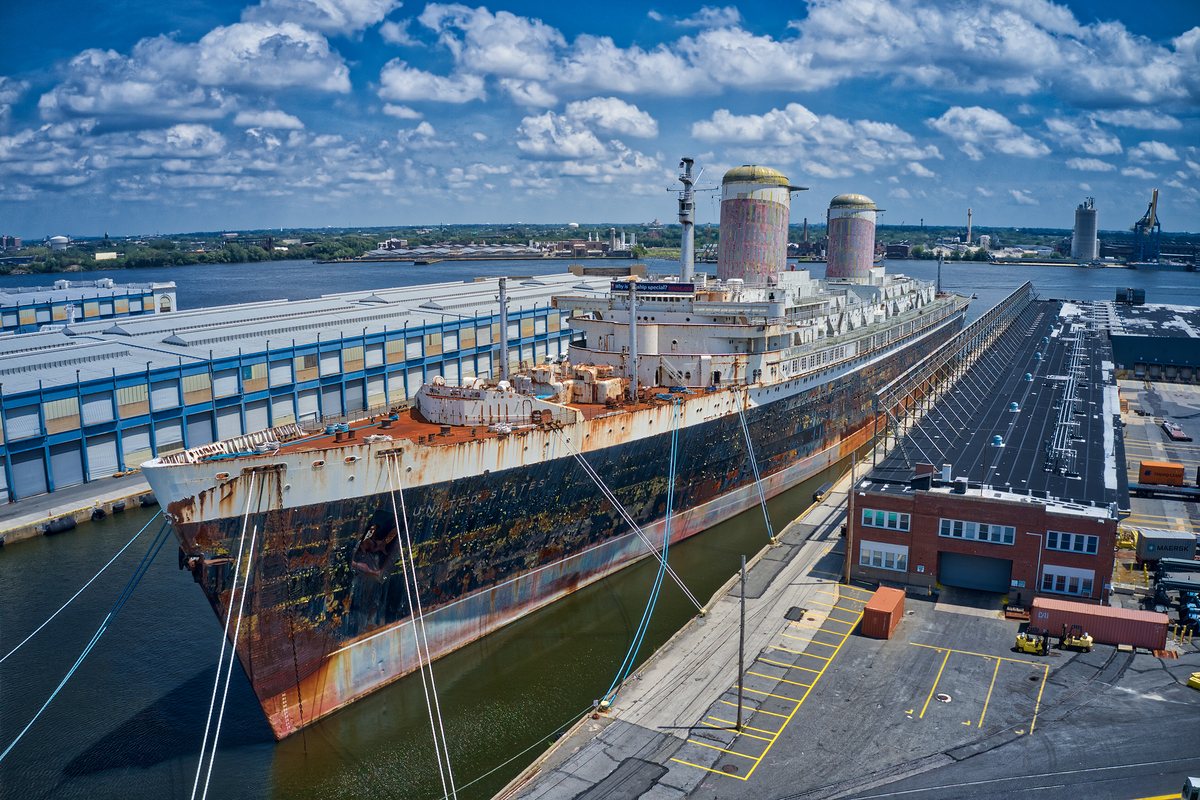
Okaloosa County, Florida, began sinking the SS United States on the afternoon of November 11, about 22 nautical miles southwest of Destin. If all goes to plan, the ship will rest in about 180 feet of water with its upper deck 55 to 60 feet below the surface.
The 990-foot liner set the transatlantic speed record for an ocean liner on its maiden voyage in 1952, a record no liner has beaten. Retired in 1969, it passed through several owners and spent its last nearly 30 years tied up at a pier in Philadelphia.
The county says a full restoration would have cost hundreds of millions of dollars, leaving a choice between scrap and a reef. It is betting on fish and tourists: a wreck this size should draw reef fish such as snapper and grouper, as well as open-water hunters such as tuna and mackerel that gather around large structures to feed on the smaller fish they attract, and with them divers, charter fishing boats and commercial fishermen. It has budgeted $13 million for the whole project: buying the ship, towing it, cleaning it and helping fund a museum on land. The money comes from a tourist tax on short-term rentals and from local partners, not the county's general fund.
02The federal cleaning checklist
The county says it prepared the ship under a 2006 guide from the Environmental Protection Agency and the Maritime Administration, the national standard for readying vessels to become reefs.
The guide asks for fuel and oil to be removed so no sheen appears when the ship sinks, and for loose asbestos to be removed, with crumbling asbestos removed or sealed. It says every manufactured item containing 50 parts per million or more of solid PCBs should come out, along with all liquid PCBs. PCBs, industrial chemicals once common in ship wiring and paint, have been banned from US production since 1979.
The paint rules are looser. Peeling paint should go, the guide says, as should active anti-fouling coatings on the hull. The guide notes that old marine paint can contain heavy metals such as lead, chromium and zinc, but intact paint, it says, generally does not need to be removed.
The guide also says it is not a regulation and binds no agency. Sinking a ship still needs separate approvals, such as a permit from the Army Corps of Engineers.
03The carrier that went down with its PCBs
The first big ship prepared under that guide, then still a draft, was the aircraft carrier Oriskany, 911 feet long, sunk about 23 miles south of Pensacola.
On February 15, 2006, the EPA gave the Navy and the State of Florida a risk-based approval to sink it with an estimated 700 pounds of PCBs still in gaskets, cables, insulation and heat-resistant paint, after a risk assessment found no unreasonable risk. The approval came with a condition: Florida's Fish and Wildlife Conservation Commission had to monitor whether fish caught at the site stayed safe to eat.
The EPA guide puts the Oriskany project's cost at $15.63 million, including $3.74 million for PCB modeling and risk assessment. The SS United States took a different route. The county says its wiring, fuel and non-metal fittings were stripped out during about a year of work in Mobile, Alabama, and that all required cleanup is complete.
04This time, the fight is over paint
Preservationists and some environmental campaigners have targeted the zinc chromate primer on the ship's steel. They argue that as it breaks down it will release hexavalent chromium, a known carcinogen, into the Gulf and its fish. A preservation group asked a court to halt the sinking and lost.
The county counters that the coating is not a federally regulated substance when it comes to artificial reefs, and that the saltwater Gulf is nothing like a drinking-water supply.
The guide cannot settle the argument. It flags chromium as a possible paint ingredient, yet, for paint, sets a removal threshold only for PCBs and lets intact paint stay. The county has published no figure for how much chromium remains on board.
05What comes next
The ship went down far more slowly than planned. Officials had said it could sink in under an hour once flooded; instead the work dragged on through the afternoon and into the evening, according to news reports. As of late November 11, US Eastern time, the county had not announced that the ship had settled on the bottom.
The next question is what the wreck releases. The county has not said whether fish at the site will be tested, as they were required to be at the Oriskany. The county plans to open the wreck to divers and fishing boats once it settles.