Trinidad and Tobago's buggery law breaches rights, Privy Council rules
Britain's Privy Council, the final court of appeal for Trinidad and Tobago, has ruled that laws criminalising sex between consenting adults of the same sex breach the constitution. The government argued two constitutional shields protected the laws. The court rejected both; only the exact wording of the fix is still to be settled.

01The ruling
Five judges of the Judicial Committee of the Privy CouncilThe Privy Council is an old body that advises the British monarch. Its Judicial Committee works as a court. It is separate from the UK Supreme Court, though mostly the same justices sit on it. It hears final appeals from some Commonwealth countries and UK overseas territories, applying their own laws. ruled unanimously on November 10 that two sections of Trinidad and Tobago's Sexual Offences Act 1986 breach the right to respect for private and family life in the country's constitution.
Trinidad and Tobago, a Caribbean nation off the coast of Venezuela, became independent from Britain in 1962 but still sends its final appeals to the Privy Council in London, a court staffed mainly by UK Supreme Court justices.
02What the law punishes
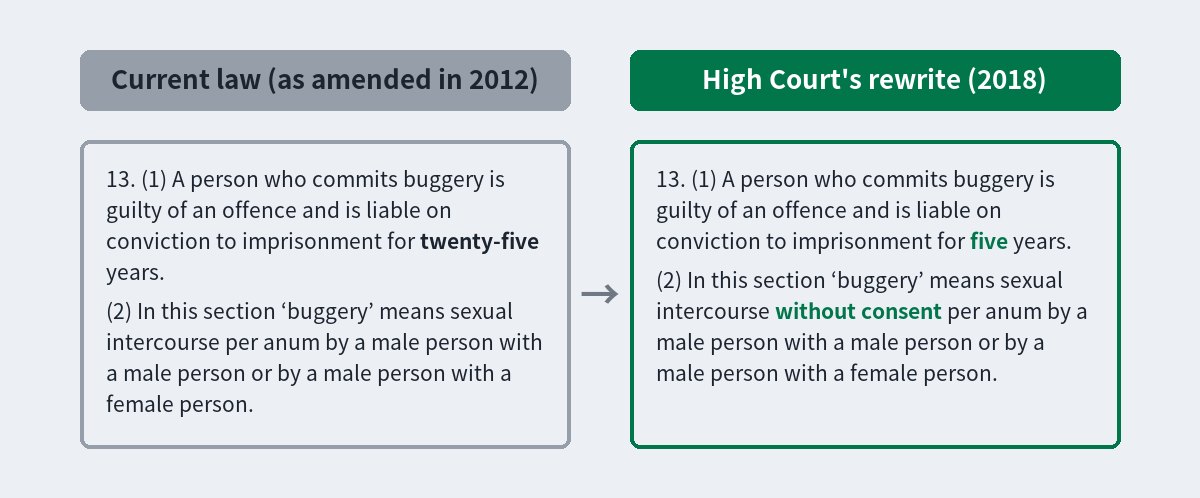
Section 13 makes buggery a crime whether or not both people consent. Since a 2012 amendment, the maximum sentence has been 25 years. Section 16 criminalises "serious indecency", with exceptions only for husband and wife, or a man and a woman aged 16 or over who both consent, acting in private.
The case was brought in February 2017 by Jason Jones, a gay man born in 1964 and raised in Port of Spain, the capital. He asked the courts to declare that the two sections breached his constitutional rights. No one had been prosecuted under them for many years, but he said their existence alone harmed him. In unchallenged evidence he described near-daily harassment and abuse in public, avoiding public transport for fear of his safety, and being attacked several times with rocks, glass bottles and pieces of wood at his performances as a singer, without protection from the police. He lived in constant fear of arrest and punishment. After years of harassment and discrimination he moved to England in 1996, returning to live in Trinidad from 2010 to 2014.
The trial judge agreed that the law made his private life criminal, ignored his dignity to choose whom to love and live with, treated him differently from heterosexual citizens and gave others a reason to see him as of lesser value.
03Two shields, both rejected
The government argued that the constitution protected the law in two ways. The first was a "savings clause". Section 6 shields laws that existed before the 1976 constitution from rights challenges. Section 6(2) covers later laws that re-enact those old laws with changes: where a new law restricts rights further than the old one, the old rules snap back in its place. Sex between men was already a crime under a 1925 colonial-era ordinance.
In March 2025 the Court of Appeal accepted the savings-clause argument and put the older rules back in place. Under that ruling, sex between consenting adult men would still have been a crime, with a maximum of five years. The Privy Council did not. The 1986 act said it would "repeal and replace" the old law, the judges noted, and it was a fresh, comprehensive code drafted after a Law Commission review. Clauses that shield old laws from rights challenges should be read narrowly, they said, or they would hollow out the constitution's purpose.
The second shield was section 13. A law that declares it overrides fundamental rights and is passed by three-fifths of all members of each house stands even if it conflicts with those rights, unless it is shown not to be "reasonably justifiable" in a society that respects individual rights. The 1986 act was passed that way.
04Judged by today's standards
Every judge in the lower courts had found the law unjustifiable under section 13. Only at the Privy Council did the government argue that justification should be measured by the standards of 1986, since attitudes had shifted over 40 years. The court disagreed: the test applies when a person's rights are before the court, which is now.
The government's only justification was that the law was traditional. The judges said the mere survival of a repressive colonial-era law could not be a legitimate aim, and a living social tradition could count only with evidence that it is still widely accepted. The government had offered none. Even if tradition were a legitimate aim, they said, the law intrudes too deeply into private life to strike a fair balance.
05What's next
The core ruling is settled; only the exact wording of the fix is not. The Privy Council will take further written arguments before issuing a final order.
The ruling already says the two sections cannot be used against private, consensual sex between adults of the same sex. Its provisional view is to keep the fix ordered by the High Court on September 20, 2018, which limits section 13 to sex without consent and cuts the maximum sentence to five years. Lawyers for Mr Jones want both sections struck out entirely, arguing that other criminal laws already cover any conduct that should be punished; the judges said tidying up overlapping offences is a job for Parliament, not the courts.
The section 6(2) part of the ruling applies only to Trinidad and Tobago. The judges called section 6(2) apparently unique: neither side's lawyers could point to a similar clause anywhere else. But the court's other points, that clauses shielding old laws must be read narrowly and that justification is judged by today's standards, could be cited in challenges elsewhere. Advocacy groups from Belize and Bermuda were among those who intervened in the case.
Corrections
- We corrected the age in the section 16 exception to '16 or over', as the statute says, and added the exception for husband and wife. We also added what Mr Jones asked the courts to declare and more of his unchallenged evidence, as set out in the judgment.