Kahneman's $75,000 happiness ceiling, revisited
Matthew A. Killingsworth, Daniel Kahneman, Barbara Mellers · PNAS, 2023
01Two answers to one old question
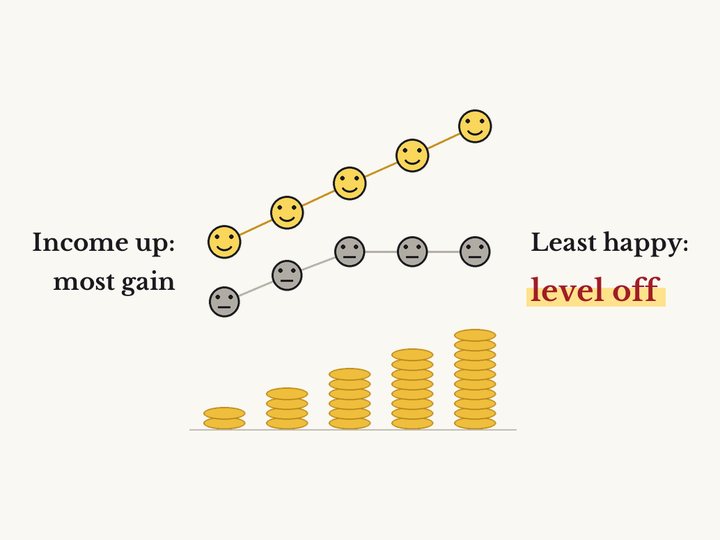
In a 2023 study of 33,391 American workers, happiness kept rising with income well past $100,000 for most people. The exception was the least happy 15%.
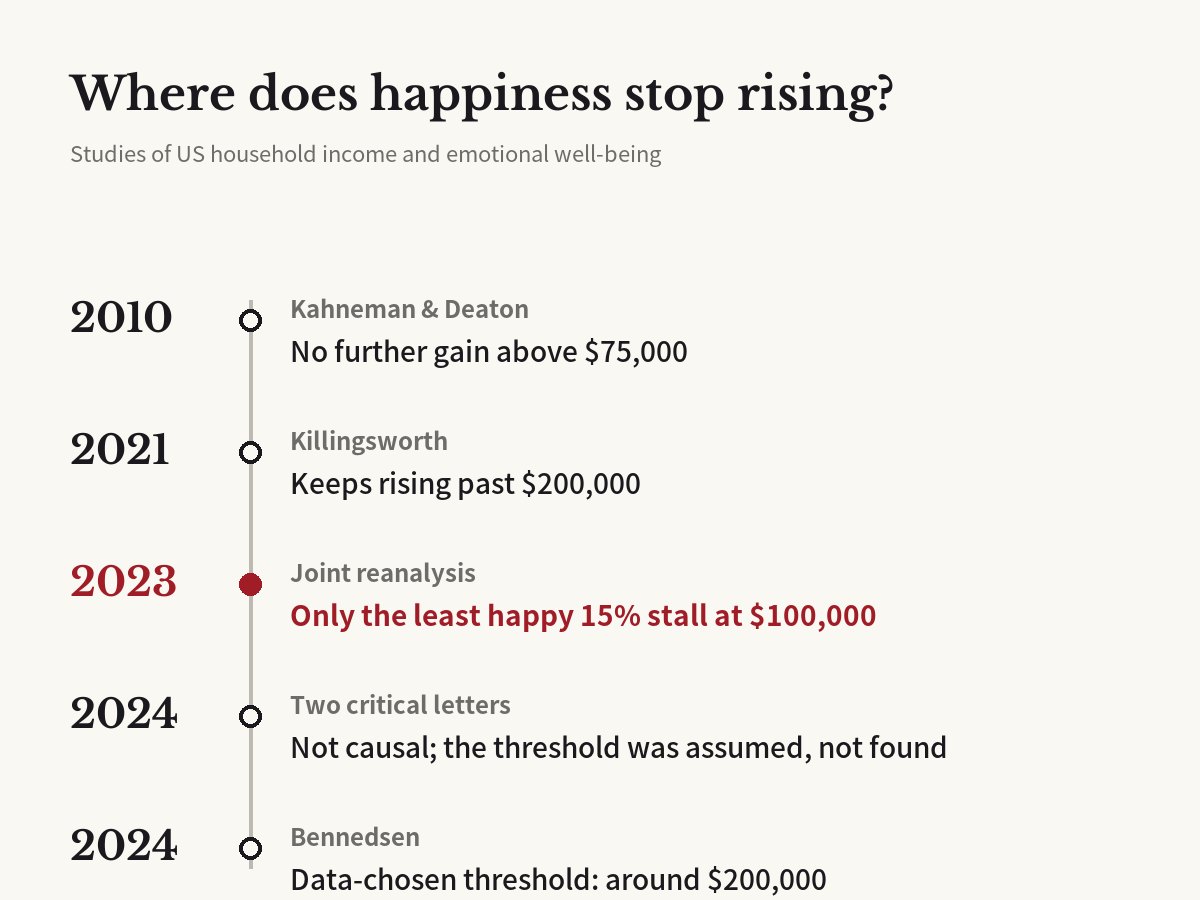
Does money buy happiness? In 2010, Daniel Kahneman, the Nobel-winning psychologist, and economist Angus Deaton said yes, up to a point. Using more than 450,000 responses to a daily Gallup poll of 1,000 Americans in 2008 and 2009, they found that emotional well-being stopped improving at about $75,000 a year. That figure, quoted ever since, was simply the middle of the poll's $60,000 to $90,000 income bracket.
In 2021, Matthew Killingsworth, a researcher at the University of Pennsylvania's Wharton School, found no such ceiling. His app pinged 33,391 working US adults on their phones, usually three times a day for several weeks, and asked: how do you feel right now? People answered on a sliding scale from "very bad" to "very good". Across 1,725,994 reports, average happiness kept rising with income, well past $200,000.
Instead of trading rebuttals, the two men tried an adversarial collaboration: rivals reanalyze the data together, with a friendly referee. Barbara Mellers, also of the University of Pennsylvania, took that role. Their joint paper appeared in PNAS in March 2023.
02What the split data showed
The team did not look only at the average. Within each income band they lined people up from least to most happy and tracked the 15th, 30th, 50th, 70th and 85th percentiles. Then they compared slopes below and above $100,000.
For most people, happiness rose with income on both sides of the line. For the happiest, it rose even faster above $100,000. The exception was the bottom: the 15th percentile climbed quickly up to $100,000 and then barely moved, a change that was not statistically significant. The authors say roughly 15 to 20% of people often feel bad, and for them the link with income takes a different shape.
Why did the 2010 study see a plateau for everyone? The Gallup questions asked whether people had felt happy for much of the previous day, yes or no. At higher incomes the average answer on the positive items was already 89% of a perfect score, so the questions could not tell happy from happier. In effect, they measured unhappiness. The $100,000 line came from the 2010 study: its $90,000 upper limit, adjusted for inflation, is about $97,000, which falls in the $90,000 to $100,000 band.
03Limitations
This is a snapshot comparing different people at one time, so it does not show that a raise makes any one person happier. The authors say they used words like "increase" only for ease of reading.
The link is also weak. The correlation between average happiness and income was 0.09, and median happiness at $15,000 and at $250,000 differed by about five points on a 100-point scale. In the 2010 data, a roughly fourfold difference in income mattered less than a third as much as having a headache.
Participants were not chosen to represent the US population. Their median age was 33 and median household income $85,000; 36% were men and 37% were married. About 91% reported household incomes under $200,000, and only 1.2% reported more than $500,000, so the top of the curve rests on few people. Income was pre-tax household income, not money people could actually spend, and the sample was American only.
04The pushback
In late 2024, PNAS published two critical letters alongside a reply. Julia Rohrer of Leipzig University's Wilhelm Wundt Institute for Psychology and Sebastian Wenz of GESIS, the Leibniz Institute for the Social Sciences, argued that a simple correlation, with no controls for other factors, cannot show that money eases suffering. They added that the method only describes "the least happy 15%" as a group of real people if everyone keeps their happiness rank as income changes, which they found implausible.
Ruben Arslan, of the same Leipzig institute, questioned the threshold itself. The $100,000 line was taken from the 2010 study rather than estimated from the data. Working from published summary data, because the raw data were not released, he found that a bent curve fitted no clearly better than a straight line. If there is a bend, he wrote, it may come after $200,000, where data are thin.
The authors replied that causation was never their aim; they set out to reconcile two conflicting correlations. They pointed to the few studies that can test cause and effect, which suggest that more money does, on average, make people happier. Kahneman died in March 2024, before the reply was published.
A separate 2024 analysis in Economics Letters by Mikkel Bennedsen let the data choose where the line falls and found the relationship flattening above roughly $200,000, while stressing that more research is needed.
Other work suggests income is linked more to sadness than to joy. A 2015 study of 12,291 Americans led by researchers at the University of British Columbia found higher income went with less daily sadness but not more daily happiness. A German follow-up the next year found the same pattern, although changes in a person's own income did not predict their sadness. Taken together, income may track bad moods more closely than good ones. Where that link levels off is still unsettled.
Original paper
- Killingsworth, Kahneman & Mellers (2023), PNAS 120(10), e2208661120, doi:10.1073/pnas.2208661120
- doi.org/10.1073/pnas.2208661120
Also checked
- Kahneman & Deaton (2010), PNAS
- Killingsworth (2021), PNAS
- Rohrer & Wenz (2024), PNAS letter
- Arslan (2024), PNAS letter
- Killingsworth, Kahneman & Mellers (2024), PNAS reply
- Bennedsen (2024), Economics Letters
- Kushlev, Dunn & Lucas (2015), Social Psychological and Personality Science
- Hudson, Lucas, Donnellan & Kushlev (2016), Social Psychological and Personality Science
- Crossref 인용 정보